Primary question: How should a buyer specify 3M VHB tape and compare an equivalent construction?
Direct answer: A 3M VHB part number identifies a product, not a specification. It points to a family and a model, while the values you actually buy - thickness, colour, liner, roll size and converting - come from the technical data sheet and the sales specification. Read the number as a name, then confirm the values before you compare a candidate or ask for a sample.
Most enquiries start with a model number and a joint that failed. The number is a useful starting point and a poor ending point: it cannot tell you how much gap the tape fills, which surface pair it suits, or what peel value applies under your test conditions. This guide sets out what the number fixes, how to read the model rows that do exist, how to screen an equivalent construction, how to validate one on production parts, and what a complete sample request contains.
Which two surfaces will the tape actually bond?
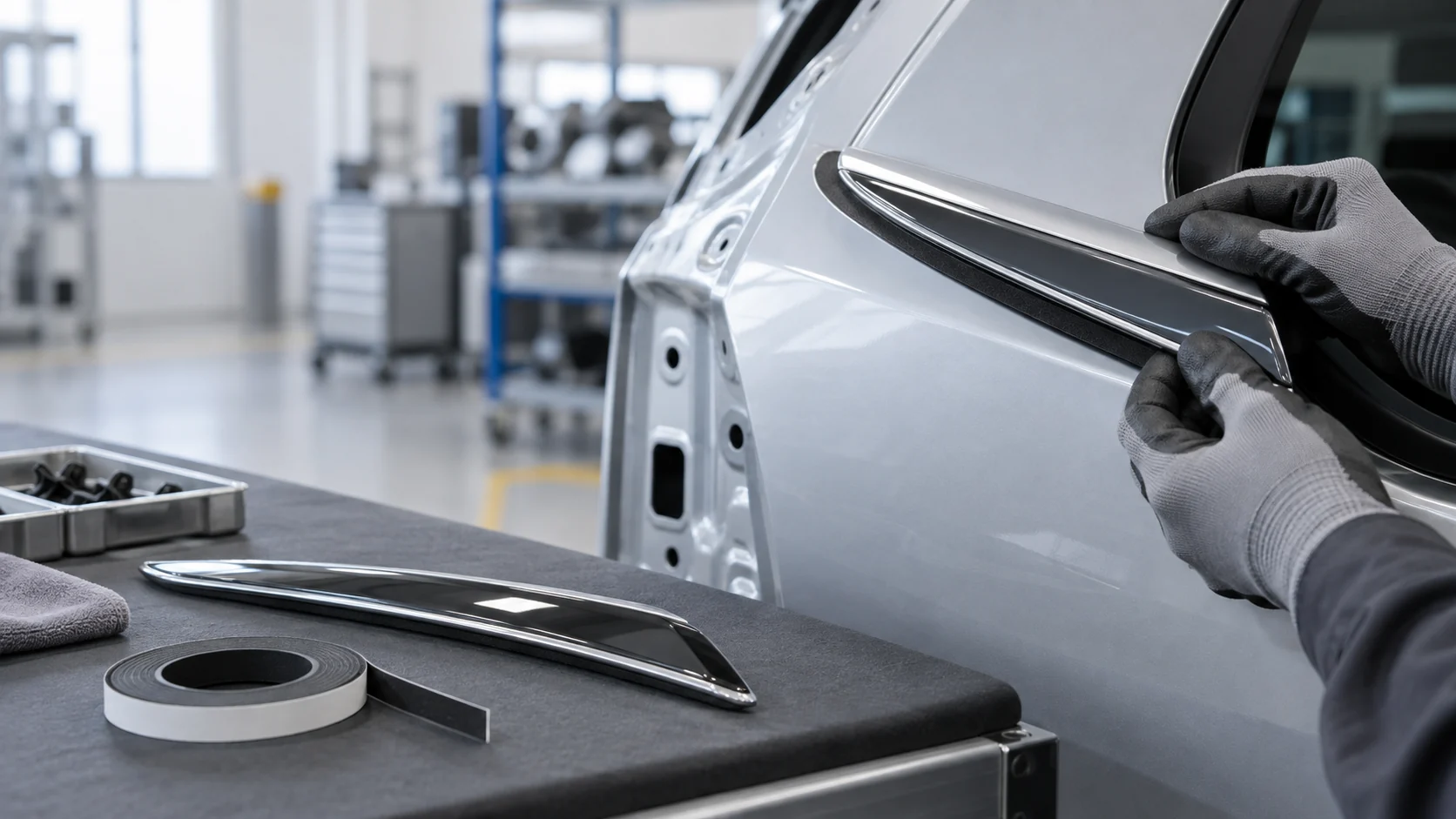
A trim joint has two faces, and they are rarely the same material. One side may be a painted or coated metal panel, the other a moulded plastic, a coated profile or a foam block. Write both faces down with their finish, because the coating presented to the adhesive can differ from the material named on the drawing. Low-surface-energy plastics and oily or release-agent contaminated surfaces are where most unexpected failures begin, and no model number compensates for a surface pair that was never defined.
Preparation also belongs in the record: wiping, priming, flame treatment and the dwell time before load all change the contact the adhesive can make. When the second face is still unknown at the time of the request, saying so lets a supplier quote against the known face and flag the missing one instead of guessing both. A failed part and an unused piece of the same lot are the only evidence of which interface separated, and they cost nothing to keep.
A 3M VHB adhesive tape part number is the usual starting point.
Which construction family fits the joint?
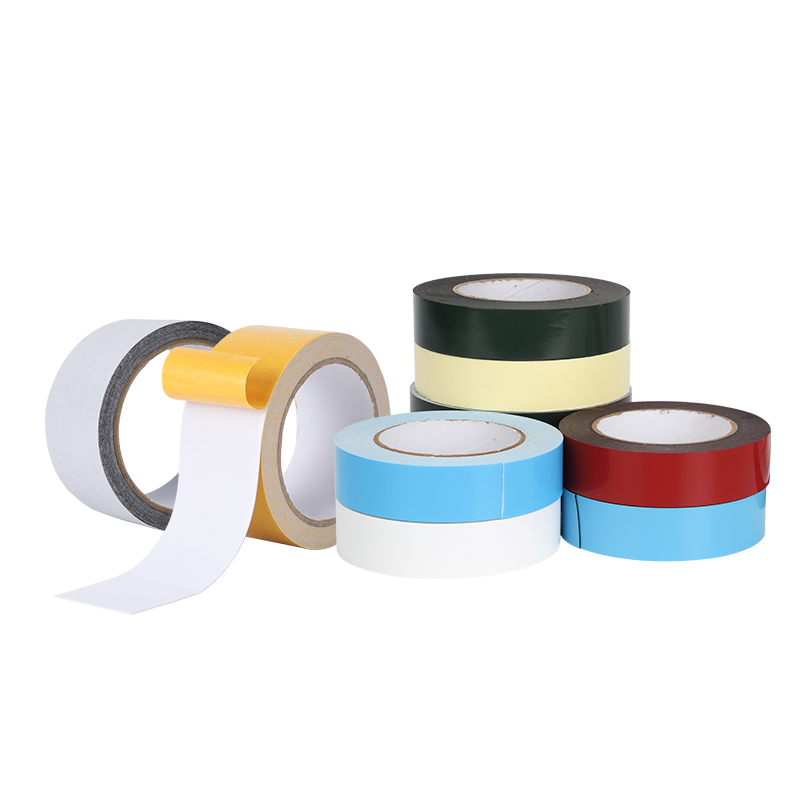
Construction comes before model numbers. A carrier - a foam core, a film or a tissue layer - sits between two adhesive layers, while a carrier-free transfer adhesive is supplied on a liner with no core. The carrier sets handling, conformability and how much gap the joint can absorb, and those three properties decide whether a joint is a candidate at all. The families we publish are closed-cell PE foam and EVA foam carriers with acrylic adhesive; a VHB number belongs to a different acrylic foam family, so the honest comparison is at the level of construction, thickness and test, never a claim that one replaces the other. A VHB model and our closed-cell foam are both double sided tape constructions, but a double tape of that class uses an acrylic foam core we do not coat.
A VHB double sided tape is not a VHB double tape construction of ours, and the VHB adhesive system behind both is acrylic foam.
Screening axes for an equivalent construction
| Axis | What to record | Why it changes the candidate |
|---|---|---|
| Substrate pair | Both materials and their finishes | Adhesion is a property of the pair, not of the tape |
| Joint gap | Gap at the bond line, plus tolerance | Sets the thickness band before any model is compared |
| Load mode | Peel, shear, tensile or mixed; static or cyclic | A tape chosen for peel may be wrong in shear |
| Temperature | Continuous service, excursions, and duration | Short excursions and continuous heat are different questions |
| Environment | UV, moisture, solvent, plasticiser contact | Drives the carrier and adhesive chemistry |
| Appearance | Visible bond line, colour match, texture | Limits which colours and carriers are acceptable |
| Converting | Roll, slit roll, die-cut part or sheet | Decides the supply format and the liner |
| Validation | The test the buyer will run to accept it | Defines what the sample must survive |
Settle these axes on paper before contacting anyone. A buyer who arrives with the surface pair, the gap and the load mode gets a construction proposal; a buyer who arrives with a model number gets a question back.
The PE foam versus acrylic foam comparison settles the carrier question before a model is chosen.
What does the part number fix, and what belongs to the data sheet?
A part number is an identifier. It tells a supplier which product you mean, and it narrows the family, but it does not by itself fix every value you are buying. Thickness, colour, carrier, liner, roll size and converting are stated on the technical data sheet and on the sales specification, and the same model is commonly sold in several roll sizes. Two buyers quoting one model number can therefore be buying different rolls.
That distinction matters because it changes what a comparison can claim. When two model rows differ in thickness, the difference is a design input, not a ranking: a thicker construction fills more gap and carries more edge stress, and a peel figure measured on one substrate under one method does not transfer to your joint.
Where each value is actually fixed
| Value | Fixed by |
|---|---|
| Product family and model | The part number |
| Nominal thickness | Technical data sheet |
| Colour and carrier | Technical data sheet |
| Liner type | Technical data sheet and sales specification |
| Roll width, length, splice | Sales specification |
| Converting (slit, die-cut, sheet) | Purchase order and drawing |
What the reviewed sources actually say about three models
| Model | Nominal thickness | Colour / carrier | Liner | Source of this row |
|---|---|---|---|---|
| 3M 5952 VHB tape (5952F) | 1.1 mm | Black acrylic foam | Not stated in the listing | Distributor listing, 2026-10-21 |
| 3M 4910 VHB tape | 1.0 mm | Transparent acrylic foam | PE film | Operator-reported from 3M page, not re-fetched |
| 3M RP+230GF | 2.3 mm | Not stated in the reviewed material | Not stated | Operator-reported from 3M TDS, not re-fetched |
Only one of those rows carries an adhesion figure here: the distributor lists 5952F at 49 N/cm with a stated maximum use temperature of 150 C. The other two rows are left without a peel value on purpose - the TDS pages that publish them could not be retrieved from this host, and a number copied without its method and substrate would be worse than a blank. Treat every value in this table as a reason to open the current data sheet, not as the data sheet.
The 3M 5952 VHB tape row, the 3M VHB 5952 listing and the 3M 4910 VHB tape row each name their own source.
Our published acrylic foam tape construction is the nearest family we list, and it is not the same product as a VHB model.
How should the candidate be tested on the real part?
Peel adhesion of pressure-sensitive tape is measured under ASTM D3330, and that designation is what to quote when a supplier and a buyer compare figures. Naming the method is the step most requests omit: two peel numbers produced under different angles, dwell times or substrates are not comparable, however precisely they are written.
Peel is also only one loading mode. A joint can fail in shear, in tensile, or at an edge where peel starts and propagates, and a peel value does not establish the load capacity of an assembly. Temperature needs the same care: a stated maximum use temperature is not a selection threshold, because short excursions, continuous service and load at temperature are three different questions, and figures from different series are not directly comparable.
A validation sequence that produces evidence
- Test on the production surfaces with the production preparation, not on bare test panels.
- Hold substrate pair, bonded area and load direction constant between candidates.
- Change one variable per round - thickness, or adhesive, or application pressure.
- Record where the joint first moves, how far, and after what conditioning.
- Keep the failed parts; edge lift and cohesive failure point to different corrections.
A trial that changes thickness, adhesive and pressure at once produces a result nobody can interpret. Run the rounds in order, write down the acceptance test before the first sample is bonded, and the sequence itself becomes the evidence a buyer can show internally.
The closed-cell PE foam tape specification is the sheet to hold beside the candidate before the first sample is bonded.
How is the tape removed if the part has to come off?
Removal is a constraint on the selection rather than a procedure to master. Published guidance for foam tapes suggests warming the tape, lifting an edge with floss or a plastic tool, and pulling slowly at a low angle so the adhesive stretches instead of tearing the surface, then softening residue with isopropyl alcohol. That guidance was written for consumer surfaces: a solvent that is harmless on glass can dull a painted panel, so test it on a hidden area and write the accepted method into the work instruction. If rework is frequent, treat removability as a screening axis and say so in the request.
What should the sample or quote request contain?
The request is where all of the earlier reading pays off. A supplier quoting from a model number has to guess the joint; a supplier quoting from the list below can propose a construction and a sample plan. These are the fields we publish as required for a quote, and they are the minimum a buyer should expect to be asked for.
Send these with the enquiry
- Original model or target construction, plus the failure you are replacing.
- Both substrates with surface and finish - bare metal, painted, plated, plastic.
- Application and joint geometry, including the gap to be filled.
- Required thickness and width, and the tolerance that matters.
- Roll format: jumbo, finished roll, die-cut part or sheet.
- Colour, liner preference and any surface appearance constraint.
- Service temperature with duration, plus any excursions or load at temperature.
- Target volume, and the acceptance test you will run on the sample.
A complete request should come back as a construction proposal, a sample plan and a workable minimum - not as another question. If the reply is only a price against the model number, the specification conversation has not happened yet, and the sample will not prove anything about your joint.
How a request like that is answered is set out under sample and OEM supply.
Frequently Asked Questions
Does a 3M VHB part number tell me the thickness and liner, or do I need the data sheet?
The part number identifies the product; it does not fix everything you are buying. Distributor listings show 5952F at 1.1 mm and 4910 at 1.0 mm with a PE film liner, and one model is sold in several roll sizes. Treat thickness, liner and roll size as values to confirm on the data sheet and the sales specification.
What information should I send with a sample request for an alternative tape?
Send the substrate and surface, the application, the thickness and width you need, the roll format, the colour, the service temperature and the target volume. That is the set we publish as required for a quote, and it lets a supplier answer with a construction instead of a question.
How should VHB or PE foam tape be removed without damaging paint?
Warm the tape, lift an edge with floss or a plastic tool, and pull at a low angle so the adhesive stretches. Soften residue with isopropyl alcohol, and test any solvent on a hidden area first.