Primary question: How should an automotive buyer select double-sided PE foam tape for trim bonding?
Direct answer: Select the tape by matching the trim substrate pair, joint gap, required conformability, service environment, assembly process, and validation plan. PE foam tape is useful when the joint needs a compressible, closed-cell layer, but the final construction still needs to be confirmed on representative parts before specification freeze.
Key takeaways
- Start with the two surfaces being bonded, not with a tape thickness chosen from a catalogue.
- PE foam is a closed-cell construction available in customizable thicknesses from 0.5–8.0 mm; the correct thickness depends on the real joint gap and tolerance.
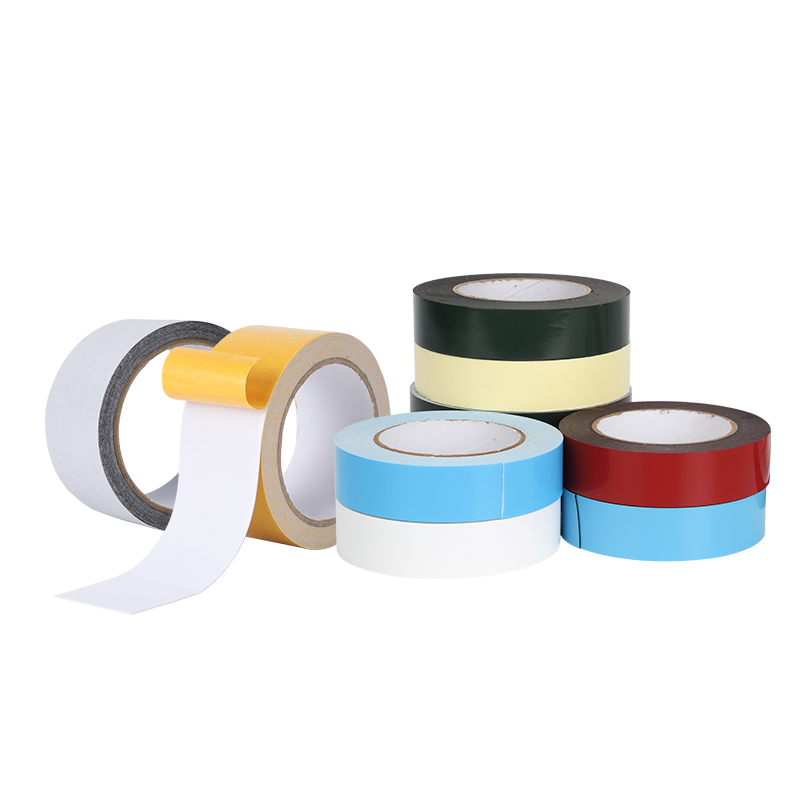
- This PE foam construction uses acrylic pressure-sensitive adhesive and is available in white, black and grey; automotive seal and mounting applications still require grade-level validation.
- Surface preparation, application pressure, dwell time and part geometry can change the real bonded area, so they belong in the validation plan.
- Selection requires the substrate pair, gap, dimensions, service environment and assembly process before a candidate construction can be narrowed down.
1. Lock the application before choosing the tape
For automotive trim, the first question is not “which thickness is strongest?” It is “what joint are we trying to build?” Record the trim material, the mating substrate, the visible-bond-line requirement, the joint width and the expected gap across the full part.
This product is a closed-cell PE foam double-sided tape with water, dust and cushioning functions. Those characteristics can be relevant to trim, sealing and mounting applications, but they do not replace a part-level test. A tape that looks suitable on a flat coupon can behave differently around a curved trim edge, a painted surface or a low-surface-energy plastic.
2. Check the substrate pair and surface condition
Adhesion is a property of the complete interface: adhesive, surface, pressure, cleanliness and time. Identify both sides of the joint. Glass, metal and painted surfaces are suitable starting points for evaluation, but the exact coating, texture and contamination still matter.
For each substrate, record:
- material and coating;
- surface energy or known bonding difficulty;
- cleaning method;
- whether primer, corona, plasma or another treatment is permitted;
- the time between preparation and tape application.
Do not describe a general engineering principle as a guaranteed product result. The practical test is simple: prepare the actual surfaces using the intended production process, apply the candidate tape with controlled pressure, and compare the bond after the required dwell and environmental exposure.
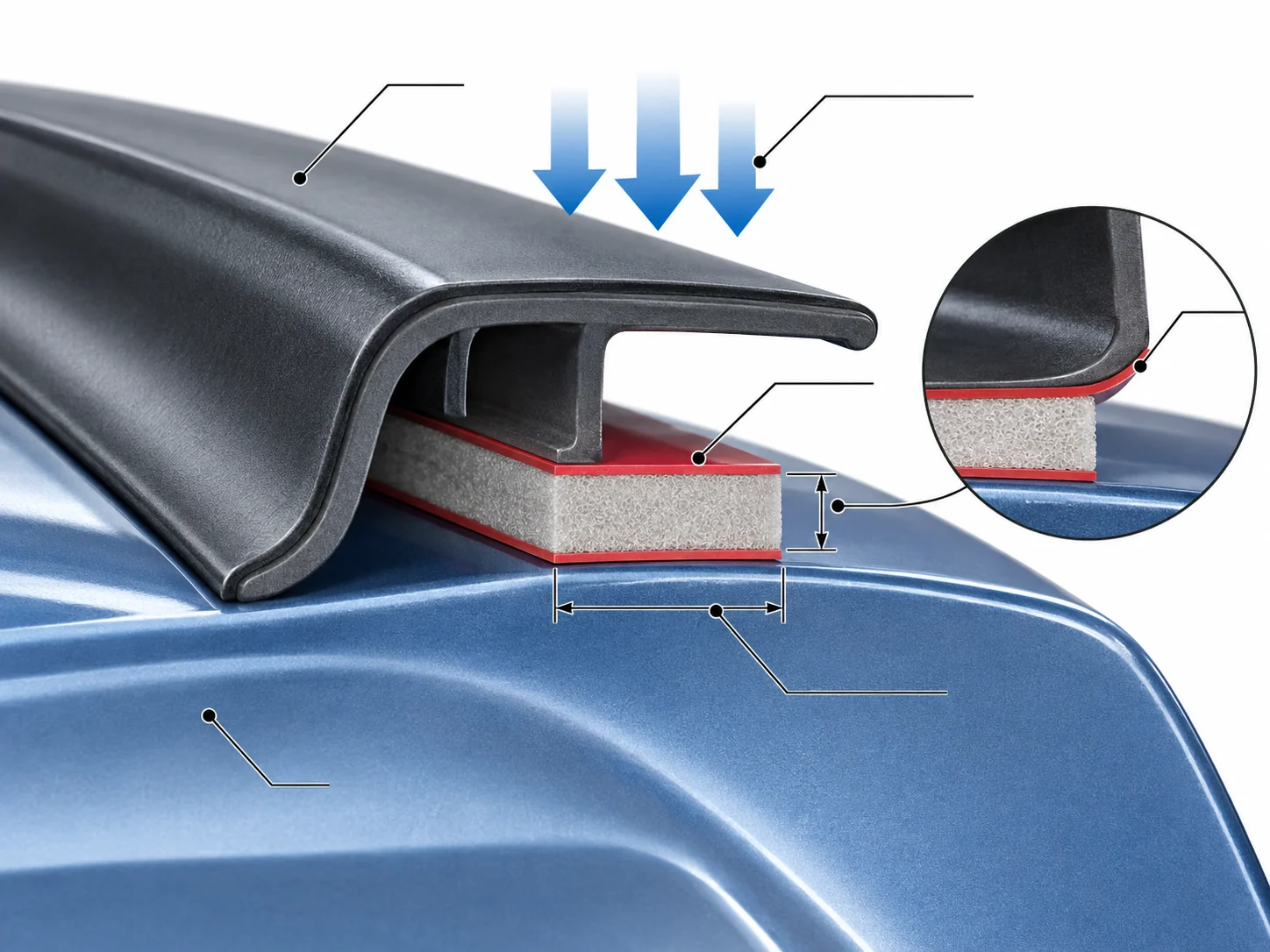
3. Choose thickness from the joint gap
PE foam tape in this product range is available in customizable thicknesses from 0.5 to 8.0 mm. That is a product range, not an automatic recommendation for every trim joint.
Measure the minimum, nominal and maximum gap. Then consider how much compression the joint can tolerate. A thicker foam can accommodate more surface variation, but it may also change the part position, increase edge exposure or create a larger lever arm at the trim edge. A thinner tape may hold a tighter stack but fail to contact both surfaces consistently when the part is uneven.
Use a simple selection table during sampling:
| Decision variable | What to record | Why it matters |
|---|---|---|
| Minimum gap | Measured on representative parts | Prevents over-compression |
| Maximum gap | Measured across the whole joint | Tests gap accommodation |
| Bond width | Drawing dimension | Determines available bonded area |
| Trim stiffness | Flexible or rigid | Changes peel concentration |
| Surface condition | Coating, texture, contamination | Changes wet-out and adhesion |
| Application pressure | Tool or roller condition | Controls actual contact |
| Dwell time | Time before loading | Separates initial tack from developed bond |
| Environment | Heat, moisture, UV and cycling | Defines validation conditions |
4. Review load and joint geometry
Trim joints rarely fail from pure shear alone. Edge lifting, peel loading, vibration and local stress around clips or corners can dominate. Keep the bond line away from sharp edges where possible, use a continuous path when the design allows it, and avoid assuming that a larger roll width automatically solves a poor joint design.
For a curved or flexible trim part, inspect whether the part is trying to spring back after application. That recovery force can concentrate stress at the edge. During validation, record the actual failure mode: adhesive separation, substrate failure, cohesive split, edge lift or loss of contact. The failure mode is more useful than a single headline strength number because it tells the buyer what needs to change.
5. Confirm the assembly process
The production process must be part of the specification. Confirm liner removal, application pressure, application speed, minimum application temperature, dwell before handling and the cleanliness standard. If the trim is installed immediately after bonding, test that condition. If it rests overnight before installation, test that condition as well.
PE foam can be considered for automotive seals and related mounting applications, but there is no universal production window for every vehicle programme. The exact construction must be validated on representative parts.
6. Information needed for PE foam tape selection
Record these inputs before comparing PE foam constructions:
- both substrate names and coatings;
- minimum, nominal and maximum joint gap;
- required bond width and roll or die-cut format;
- part dimensions and curvature;
- service temperature, moisture, UV or cleaning exposure;
- application pressure, line speed and dwell time;
- converting format and production process.
Full quotation requirements belong in a separate industrial tape RFQ guide. This page keeps only the information needed to make the selection decision.
Selection matrix
| Application condition | Selection implication |
|---|---|
| Greater gap variation | Evaluate greater foam conformability |
| Tight visible bond line | Avoid unnecessary foam thickness |
| Curved trim or spring-back | Evaluate edge peel stress carefully |
| Uneven surface | Confirm contact across the bond line |
| Difficult plastic substrate | Give more attention to adhesive and surface preparation |
| Outdoor exposure | Include heat, moisture and UV in validation |
| Immediate handling | Evaluate the initial bond before full dwell |
7. Validate before specification freeze

Use representative production parts, not only a smooth laboratory coupon. Test the actual surface preparation and application process. Include the worst realistic gap, the most difficult substrate and the highest expected environmental load. Inspect immediately after assembly and again after the agreed dwell and exposure period.
If the result is not acceptable, change one variable at a time: surface preparation, bond width, thickness, application pressure or construction. This makes the next supplier discussion actionable and prevents the common mistake of changing the tape and the process simultaneously.
Conclusion
For automotive trim, double-sided PE foam tape should be selected as part of the joint design. Start with substrate pair, gap, geometry and assembly conditions; use the 0.5–8.0 mm product range only as the starting envelope; then confirm the exact construction on representative parts. Related knowledge includes the PE foam tape product page, automotive applications page and PE foam tape vs acrylic foam tape.
Related Products
Applications in Focus
Frequently Asked Questions
Is PE foam tape suitable for automotive trim?
It can be suitable when the substrate, gap, geometry and process are compatible. The product application scope includes automotive seals, while suitability for a specific trim part still requires representative-part validation.
What PE foam tape thickness should I start with?
Start from the measured minimum and maximum joint gap, then consider compression, trim position and edge stress. The PE foam range is 0.5–8.0 mm and can be customised, but the exact thickness should be selected through samples.
What information should I send for a tape recommendation?
Send both substrates, coatings, gap range, bond width, part geometry, service environment, application process, quantity and required converting format.
Do I need to test the production process?
Yes. Pressure, cleanliness, application speed, dwell time and surface preparation affect the real bonded interface. Final decisions should use representative parts and the intended process.
Can the supplier guarantee the final bond from a drawing alone?
No. A drawing describes geometry and dimensions, but not contamination, coating condition or production pressure. The final construction must be confirmed through samples and validation.